Water Heater Repair in Chase and the Shuswap
Water heater repair is one of the calls we take most often, and it is almost never convenient. A tank fails on a Sunday, or the morning of a long weekend, or the week the family arrives. Jeff holds a Red Seal plumbing certification and a licensed B gas fitter ticket, which matters more than it sounds: a plumber without a gas ticket can diagnose an electric tank but has to hand off the burner, the gas valve and the venting on a gas one. Here, all of it is the same call. Twenty years working the same stretch of the Highway 1 corridor, and the phone is answered around the clock.
What Actually Goes Wrong
On an electric tank, the usual suspects are the upper or lower heating element, the thermostat behind the access panel, or a tripped high-limit that has been reset once too often. Lukewarm water that runs out fast usually means the lower element has failed and the upper one is doing all the work. No hot water at all, with the breaker holding, usually means the upper element or the thermostat.
On a gas tank it is more often the pilot assembly, the thermocouple, the gas control valve, or a venting problem that is shutting the burner down on a safety. A burner that lights and drops out within a minute is a classic thermocouple. A burner that will not light at all can be the valve, and on a sealed-combustion unit it can be a blocked intake, which is worth checking before anything is condemned.
On both types the failures that are not really repairs are worth naming honestly. Water on the floor from a fitting, the drain valve or the temperature and pressure relief valve is a repair. Water seeping from the shell of the tank itself is not: the glass lining has gone and the tank is finished. We will tell you which one you have before anything is ordered.
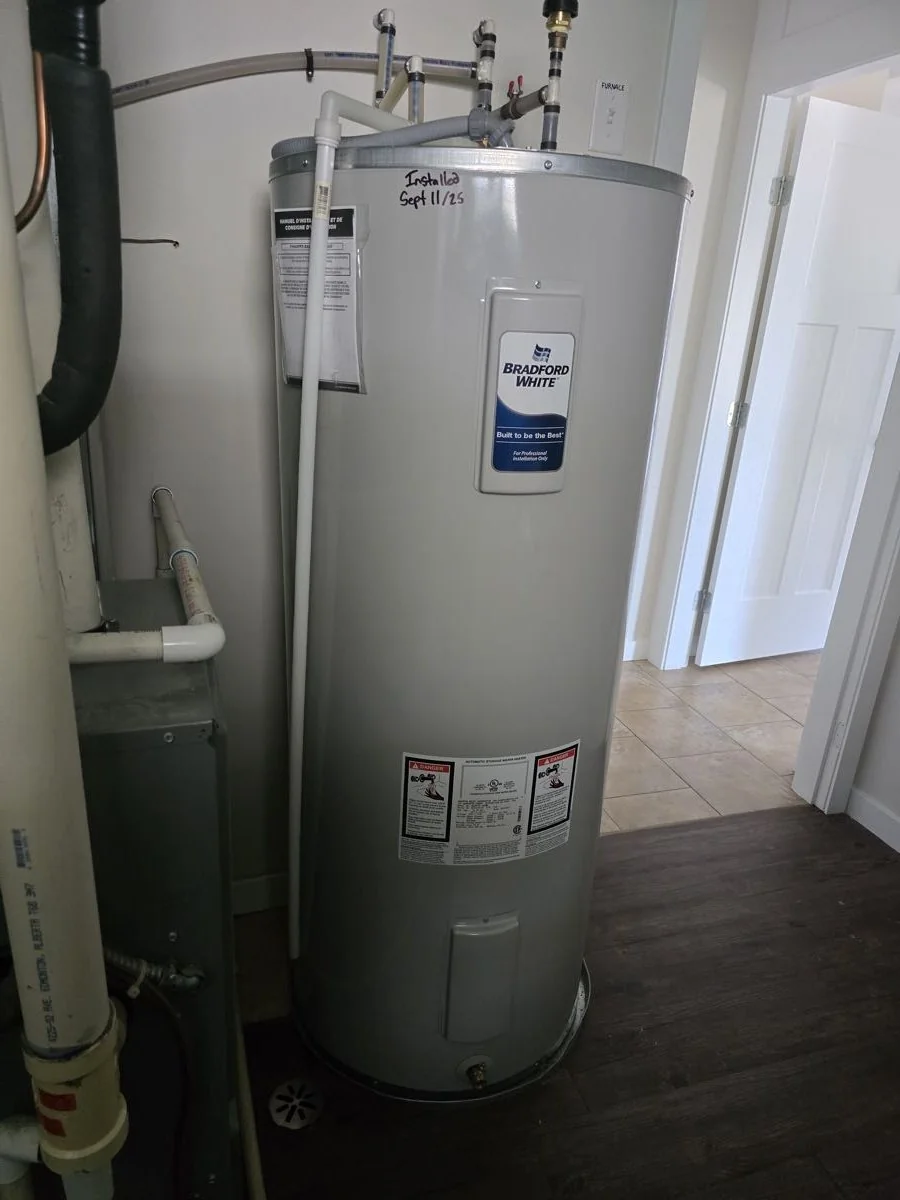
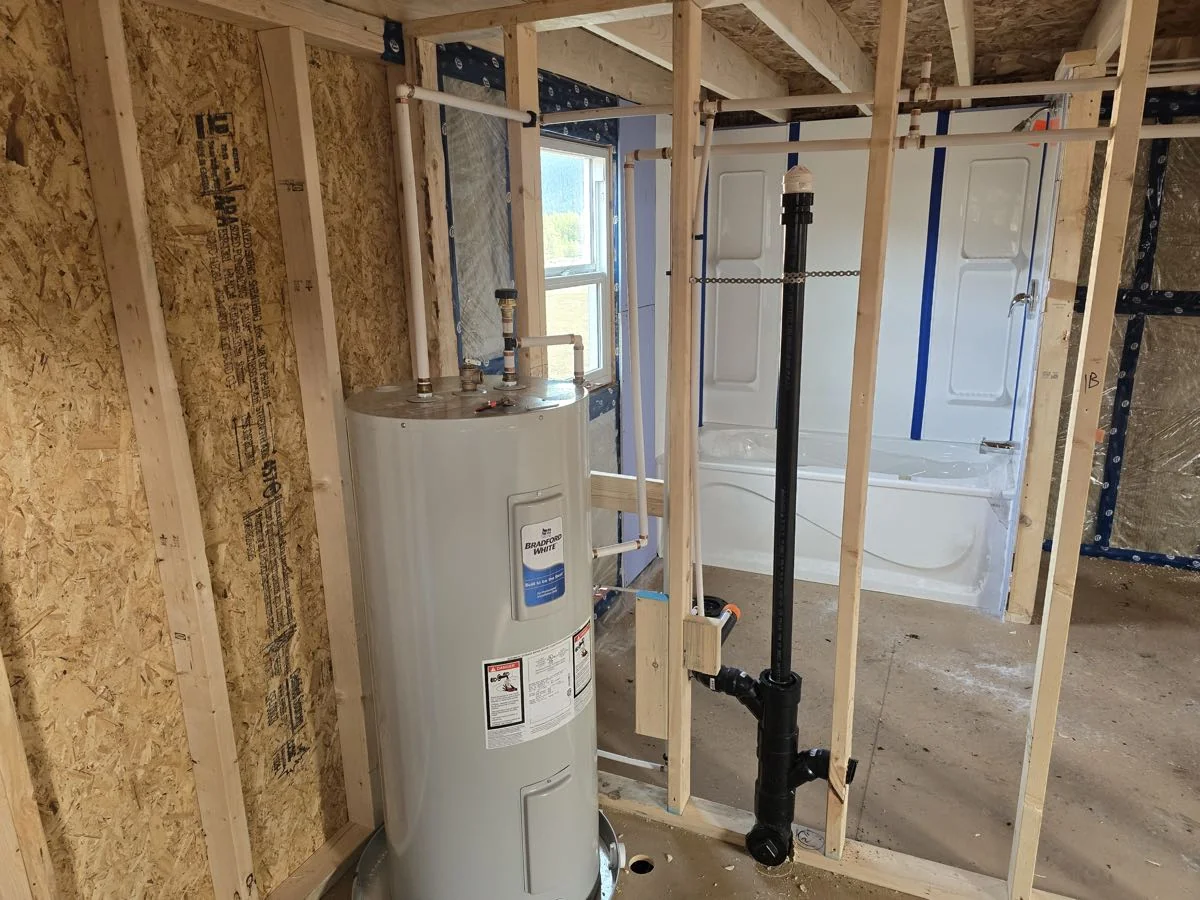
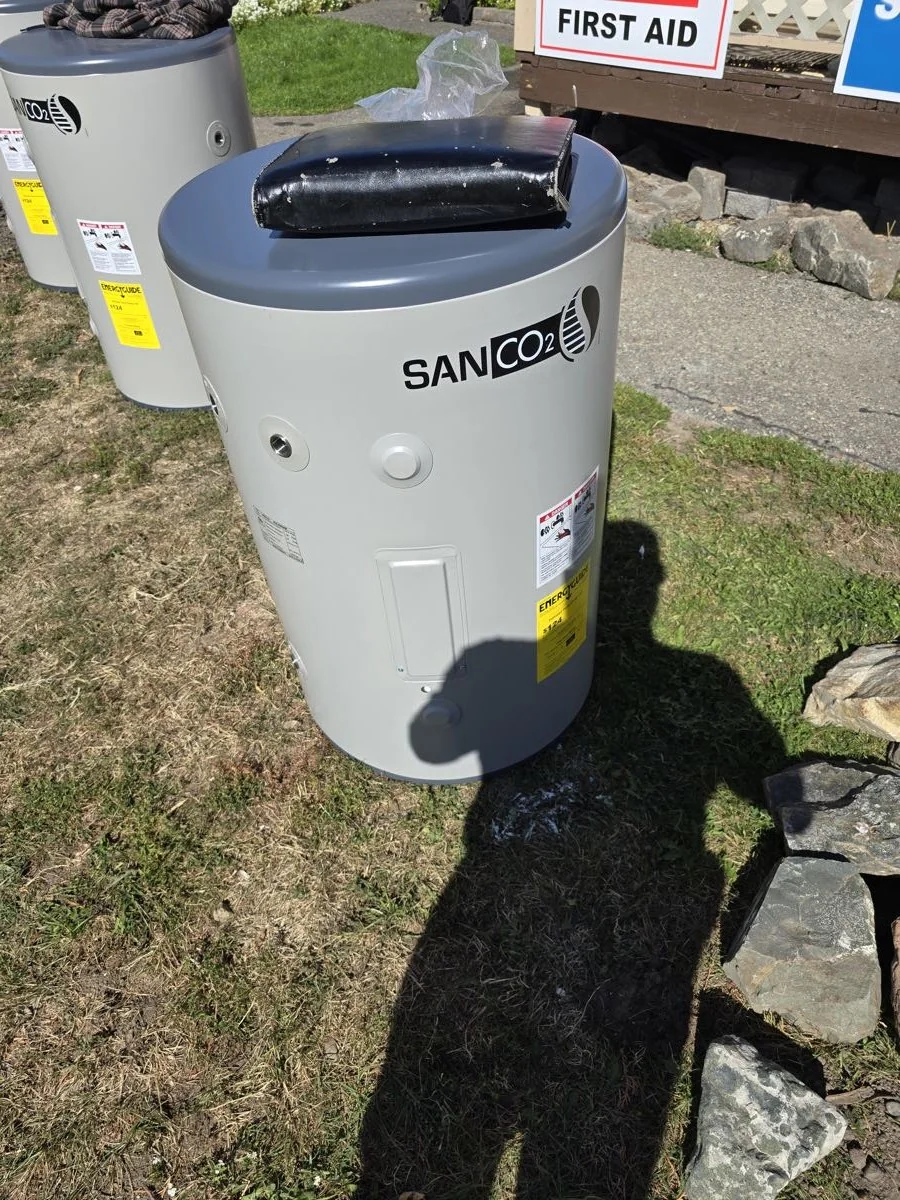
Recent Hot Water Work
Repair or Replace
A tank in the eight to twelve year range with a failed element is usually worth repairing, and a tank past that age with a failed gas valve usually is not, because the valve is a large share of what a whole new tank costs. The question we ask is what else on that tank is close to the end. If the anode rod has been gone for years and the bottom is packed with sediment, a new element buys you months, not years, and you will be paying the call-out twice.
The one case with no argument is a leaking shell. There is no repair for it, the failure gets worse rather than better, and a tank in a finished space or above a living area is worth dealing with before it opens up properly.
Hard Water Is the Reason Tanks Fail Early Here
Water through the Thompson and Shuswap carries a real mineral load, and heating it is what drops those minerals out of solution. They settle on the bottom of the tank as scale. On a gas tank that layer sits directly between the burner and the water, so the burner runs longer for the same hot water, the steel above it runs hotter than it was meant to, and the tank ages faster. The rumbling or popping people describe is water flashing to steam under that sediment layer.
Outside the village and city systems, a lot of properties around Chase and the Shuswap are on their own wells, where hardness is whatever the ground gives you and nobody is treating it centrally. The practical answer is unglamorous: flush the sediment out annually, and replace the anode rod before it is gone rather than after. A sacrificial anode is a few dollars of magnesium doing the corroding so the tank does not, and once it is consumed the tank starts spending its own steel. Most tanks we open have never had theirs looked at.
Where We Work
Chase
Chase is home, and it shapes what we see. The village was incorporated in 1969 and much of the housing stock went in through the seventies and eighties, so a lot of these tanks are the second or third to sit in that space, often in a tight utility closet or a low crawlspace where the original unit was slid in before the wall went up. Getting a full-height tank out of a room that was framed around it is half the job on some of these calls, and it is the part that gets missed when a quote is given over the phone without seeing it.
Kamloops
About forty minutes west on Highway 1. Kamloops water is hard enough to be the main thing shortening tank life across the city, and in the older North Kamloops and Brocklehurst stock there is still galvanized supply pipe in service, which scales on the inside and narrows until pressure at the fixture drops off. A tank replacement in one of those houses is worth doing with eyes open about what the supply line is going to do next.
Salmon Arm
Roughly thirty-five minutes east. Salmon Arm is on the FortisBC natural gas system, so gas tanks are common here in a way they are not everywhere in the region, and the failures skew toward gas controls and venting rather than elements. The newer subdivisions on the hill run to sealed-combustion units with plastic intake and exhaust, which fail differently and are diagnosed differently than an atmospheric tank in an older basement.
The Shuswap
Sorrento, Blind Bay, Scotch Creek, Sicamous and the lake communities in between. A large share of these properties are seasonal, and seasonal use is hard on a water heater. Tanks get drained in the fall, sit empty over winter, and are refilled in spring, which is exactly when the failures surface: an element that was left energised in an empty tank is already dead, and a tank refilled without bleeding the air will burn an element out within minutes. If the property is a rental, the discovery usually happens with guests already in the door, which is why we take these calls at odd hours.
What Moves the Price
Four things, mostly. Whether it is a part or a whole tank. Whether it is gas or electric, since gas work carries the permit and the venting. How hard the tank is to physically reach and remove, which is where the older Chase and Shuswap installs get expensive. And whether anything has to be brought up to current code while we are in there, most often an expansion tank on a closed system, proper seismic strapping, or a vent that was never right.
We would rather look at it than guess. Send a photo of the tank and its data plate and we can usually tell you on the phone whether you are looking at a repair or a replacement before anyone drives anywhere.
Common Questions
How long should a hot water tank last?
Eight to twelve years is the normal range, and hard water pulls it toward the short end. A tank that has had its sediment flushed and its anode rod replaced can go well past that. One that has never been serviced often does not reach ten.
Is it worth repairing a water heater or should I replace it?
If the tank is under about eight years old and the failure is an element, a thermostat or a thermocouple, repair is usually the right call. If it is older, or the gas control valve has failed, replacement is often cheaper over the life of the unit. If the tank shell itself is leaking there is no repair, and it needs to be replaced.
Why is my hot water rusty or smelly?
Rusty hot water usually means the anode rod is spent and the tank has started corroding internally. A rotten-egg smell is normally bacteria reacting with the anode, which is common on well water and is fixable, often with a different anode material rather than a new tank.
Why does my water heater rumble or pop?
Sediment on the bottom of the tank. Water gets trapped under the layer, flashes to steam and forces its way out. It is a sign the tank needs flushing, and if it has been going on for years it is also a sign the tank is working harder than it should be.
Do I need a permit to replace a water heater in BC?
For gas work, yes. A gas installation or alteration needs a permit from Technical Safety BC, and the licensed gas contractor pulls it before the work starts. Jeff holds a B gas fitter licence, so the permit and the work are handled together. Straight electric tank swaps are a different case, and we will tell you which one applies.
Can you replace a hot water tank the same day?
Usually, for the standard gas and electric sizes. What slows it down is an unusual size or configuration, or a space that has been framed or finished around the old tank so it has to come apart to come out.
Should I go electric, gas or tankless?
It depends on what fuel the property already has and how the hot water gets used. Gas recovers faster and suits a busy family bathroom. Tankless is a real advantage in a seasonal property that sits empty, because there is no tank of water being kept hot for nobody. We install all three and will give you a straight answer for your property rather than a preference.
Do you work outside Chase?
Yes. Chase, Kamloops, Salmon Arm, Sorrento, Blind Bay, Scotch Creek, Sicamous, Pritchard and the surrounding Shuswap. Being based in the corridor rather than driving out from a city usually means a shorter wait for the properties in between.
No Hot Water?
Call Jeff directly. Red Seal plumber, licensed B gas fitter, answering 24/7 across Chase, Kamloops, Salmon Arm and the Shuswap.
Call (604) 375-2289